Skip to content
A quartz splashback is an engineered stone panel fitted to the wall above a worktop. A low upstand covers a shorter section of wall, while a taller splashback can extend towards the wall units. A panel can match the worktop, although joints may be needed depending on the layout and slab size. Before ordering, check the material requirements and the installation instructions for your specific hob, including any required clearances.
Mo’s Stonex templates, fabricates and fits splashbacks and upstands in Elorā engineered stone, made with 0% crystalline silica, Sinterra sintered stone and Dekton. Ask our team about using the same material and colour as your worktop. Continuous pattern alignment depends on the slab, cutting layout and joints and must be confirmed for your project. Request a splashback quote.
A quartz splashback can create a clean, coordinated kitchen by continuing the worktop material onto the wall. It provides a smooth surface with fewer joints than tiles and is generally straightforward to clean.
However, quartz is not automatically suitable behind every hob, and the final result depends on the selected surface, wall condition, panel dimensions and quality of installation.
Quartz splashbacks can be beneficial when you want a coordinated worktop and wall finish with minimal grout lines and simple everyday cleaning. They are particularly effective behind sinks and preparation areas.
However, quartz is heat-resistant rather than heat-proof, so suitability behind a gas or electric hob must be confirmed using the surface and appliance manufacturers’ instructions. Cost, wall preparation, socket cut-outs and installation access should also be considered.
A quartz splashback is a fabricated panel installed vertically between the kitchen worktop and wall cabinets, extractor or shelving.
It is commonly made from the same slab or design as the worktop, although a contrasting colour can also be used.
A quartz splashback may be installed as:
Traditional engineered quartz generally combines mineral content with binders and pigments. Composition now varies considerably between manufacturers, and some newer engineered surfaces use reduced-silica or crystalline-silica-free mineral formulations.
An upstand is a relatively narrow strip of material fitted along the back edge of the worktop. It normally covers the junction between the worktop and wall.
A splashback covers a larger part of the wall. It may extend from the worktop to the wall cabinets or extractor.
Homeowners sometimes use both:
An upstand normally costs less because it uses less material. A full-height splashback provides more wall protection and creates a stronger visual feature.
| Option | Typical height | Where it is used |
|---|---|---|
Upstand | About 100mm | Along the back edge of the worktop |
Hob splashback | Worktop to extractor or wall units | Behind the hob |
Full-height splashback | Worktop to wall cabinets | A full run or feature wall |
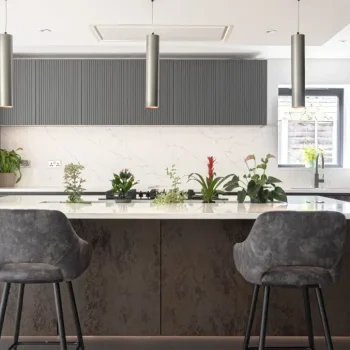
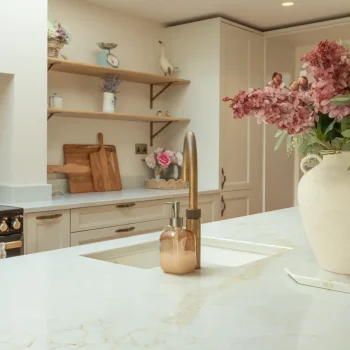
Using the same design for the worktop and splashback creates a continuous visual connection between the horizontal and vertical surfaces.
This works particularly well with marble-effect veining, soft neutral colours, concrete-inspired designs, minimal handleless kitchens and carefully aligned patterns. Continuing the material onto the wall can make the kitchen feel calmer because there are fewer changes in colour, pattern and texture.
A large quartz panel usually has fewer visible joints than a tiled splashback. Tile grout can collect discolouration, grease and cooking residue, particularly behind a hob or sink.
Silicone joints will normally remain around the edges and between separate panels. The final number of joints depends on slab dimensions, wall length, access, pattern alignment, socket positions, internal corners and extractor design.
Engineered quartz has low porosity and is generally resistant to common household staining. For ordinary cleaning, remove grease or food residue promptly, wipe with warm water and a mild neutral cleaner, rinse away residue and dry with a soft cloth.
Avoid abrasive pads and unapproved chemicals. Product-specific maintenance guidance should always take priority over general advice.
Most engineered quartz surfaces do not require periodic sealing. This can make quartz simpler to maintain than some unsealed natural stones.
However, no sealing required does not mean maintenance-free. The surface, silicone joints and surrounding areas still need regular cleaning and inspection.
Quartz and modern mineral engineered surfaces are available in plain white, warm cream, grey, black, marble-effect veining, concrete-inspired finishes, fine speckled patterns and bold decorative veining.
View a large sample or complete slab before ordering because veining and pattern distribution may look very different across a full-height panel than on a small sample.
A correctly installed splashback protects the wall from water splashes, food residue, cooking oils, steam, everyday cleaning and minor marks.
It is particularly useful behind sinks and preparation areas, where painted walls may otherwise require frequent cleaning or redecorating.
Using the worktop material for the splashback can simplify the design process. There is no need to find separate tiles, grout and trims that coordinate with the worktop.
This can also reduce uncertainty about whether different colours and patterns will work together.
Quartz is resistant to normal kitchen use, but very high temperatures or sudden thermal changes can damage the surface, binder, adhesive, silicone joints and decorated finishes.
Do not assume that a quartz colour used for a worktop is automatically approved for installation immediately behind every cooking appliance.
Suitability depends on the hob type, heat output, burner position, distance between the flame and wall, extractor arrangement, splashback thickness, surface guidance, appliance clearances and wall construction.
Gas hobs need particular attention because flames and hot gases may be closer to the wall surface.
The price may include additional slab material, templating, fabrication, edge polishing, socket cut-outs, pattern alignment, delivery, wall preparation, adhesive and installation.
A simple panel may be made from a suitable offcut, while a full-height or long panel may require additional slab material.
A quartz splashback is manufactured to the measured wall dimensions. Once cut, substantial on-site alterations may be difficult or unsuitable.
The template should account for uneven walls, worktop level, cabinets, extractor width, windows, sockets, switches, shelves, corners and visible edges.
Electrical sockets and switches require carefully positioned openings. Numerous openings can increase fabrication cost, interrupt the pattern, make the panel more vulnerable during transport and create narrow areas around cut-outs.
Moving a socket before templating may sometimes produce a cleaner design. Electrical alterations should be completed by a suitably qualified electrician.
The wall should be flat, stable and suitable for the chosen adhesive and installation method. Uneven plaster, loose tiles, damp, crumbling surfaces, significant bows and old adhesive may need attention first.
A splashback should not be used to conceal unresolved damp or structural problems.
A panel can chip or crack because of impact, movement, poor support or thermal stress. Small repairs may remain visible.
Complete replacement can be difficult when the original colour is unavailable, the pattern cannot be matched or cabinets and extractors were installed after the panel.
Quartz is heat-resistant rather than heat-proof. The kitchen designer, fabricator and appliance installer should check the instructions for the exact hob model, surface, adhesive and clearances before the panel is manufactured.
Where quartz is unsuitable, sintered stone, porcelain, stainless steel, glass or another approved material may be recommended.
Possibly, but only when the exact surface and installation have been approved for that application.
Before installing quartz behind a gas hob, confirm:
Do not rely on a general statement that all quartz is heat-resistant. Product composition and appliance arrangements vary. A sintered or porcelain surface may be more suitable where strong direct-heat resistance is a priority.
Quartz may be suitable behind many induction hobs because there is no exposed flame. However, heat from cookware, steam and the appliance itself still needs to be considered.
Check the hob installation manual, the distance to the splashback, ventilation requirements, manufacturer surface guidance, the position of large cookware and the extractor arrangement.
An induction hob does not make all installation restrictions irrelevant.
No splashback material is best for every kitchen. Compare the cooking area, visual effect, maintenance, wall condition and budget before selecting a splashback.
Choose quartz when you want:
Choose tiles when you want:
Glass can provide a smooth, joint-free appearance and is available in a wide range of colours. Toughened glass is also commonly used behind hobs when correctly specified.
Quartz may be preferred when you want the splashback to match the worktop, visible stone-style veining or a more substantial material appearance. Glass may be preferred for a plain custom colour, a thinner-looking panel or a suitably specified heat-resistant cooking area.
Matching the worktop and splashback creates a calm, continuous appearance, particularly with marble-effect designs.
A contrasting splashback may work better when the worktop already has a strong pattern, you want to introduce colour, the kitchen needs visual separation or a full matching slab would feel too dominant.
Ask whether the pattern can be aligned. Perfect vein matching is not always possible because of slab dimensions, cut-outs and fabrication requirements.
Elorā is Mo’s Stonex’s 0% crystalline-silica engineered surface and is positioned as a modern alternative to traditional quartz. An Elorā splashback may be used to coordinate with an Elorā worktop where the selected product and installation are suitable.
Confirm hob compatibility, heat clearances, panel dimensions, cut-outs, installation method and product-specific care instructions. Very hot cookware should not be placed directly against an engineered surface.
The final cost depends on the complete project rather than the panel area alone.
Important pricing factors include:
A simple panel behind a sink may cost considerably less than a full-height splashback extending around several walls. Provide kitchen plans, approximate dimensions, worktop design, hob and extractor models, socket positions and wall photographs for a more useful initial quotation.
A splashback is usually priced on the same surface price per square metre as the matching worktop, plus fabrication and fitting. As a guide, a 600mm high panel behind a 900mm hob is about 0.54 square metres of surface. Our Elorā engineered stone colours show surface prices from £150 per square metre, so you can estimate the material before you ask for a quotation. Socket cut-outs, polished edges and joints are quoted separately.
Choose the colour, pattern and finish. Decide whether the splashback should match or contrast with the worktop.
Confirm the hob and extractor models so that clearances, heat requirements and the suitability of the selected surface can be checked.
Repair significant unevenness, loose plaster, damp or other defects before final installation. The wall should be flat, stable and suitable for the fixing method.
The installer records the final wall shape, cabinets, sockets, corners and visible edges. Cabinets, worktops and appliances should normally be in their confirmed positions.
The panel is cut and finished in the workshop. Socket openings and other details are produced using the approved template.
The panel is carefully positioned and fixed using an appropriate installation system. Perimeters and joints are sealed where required. Because large panels are heavy and cut-outs can create vulnerable areas, professional fabrication and installation are recommended.
For everyday cleaning:
Avoid abrasive scouring pads, oven cleaner, paint stripper, strong solvents, prolonged bleach exposure, direct flame, unapproved steam cleaning and unapproved acidic or alkaline products.
Follow the instructions for the exact product installed in your kitchen.
A quartz splashback may be worth the cost when you value a coordinated worktop and wall finish, minimal grout lines and straightforward everyday cleaning. It may not be the most economical option when a separate slab is required or the wall contains numerous sockets and complex cut-outs.
Most engineered quartz splashbacks do not need sealing. However, the surface still requires routine cleaning, and silicone joints should be checked periodically. Always follow the care guidance supplied by the selected manufacturer.
Quartz offers some heat resistance but should not be described as heat-proof. High temperatures and thermal shock can damage engineered quartz. Suitability behind a hob must be checked for the exact surface and appliance.
Yes. A splashback may crack because of impact, wall movement, poor installation, insufficient expansion allowance or excessive heat. Correct wall preparation, fabrication and installation help reduce the risk.
The existing wall must be assessed first. Installing directly over tiles may not be appropriate if the tiles are loose, uneven or unsuitable for the adhesive system. Removing the tiles and preparing a flat, stable wall may produce a more reliable result.
Yes, accurately positioned openings can be fabricated for sockets and switches. Their positions must be confirmed before manufacture. Electrical alterations should be completed by a suitably qualified electrician.
The low porosity and smooth surface make engineered quartz easy to wipe and less dependent on grout joints than tiles. Hygiene still depends on regular cleaning, and the surface should not be claimed to prevent all bacteria or mould growth.
Sometimes. It depends on slab size, worktop layout, splashback dimensions, pattern direction and available offcuts. The fabricator should plan the slab layout before cutting to determine whether matching sections are possible.
A quartz splashback may be a good choice when you want:
Consider another material when:
The safest approach is to select the worktop, splashback, hob and extractor together so that appearance, dimensions, heat clearances and installation requirements can be checked before manufacture.
Quartz splashbacks can provide a clean and coordinated kitchen finish, especially when matched with the worktop. Their smooth, low-porosity surface is generally straightforward to maintain, and the reduced number of grout lines can make cleaning simpler than with small tiles.
However, quartz is not heat-proof, maintenance-free or suitable behind every appliance. Confirm the manufacturer’s guidance, hob clearances, wall condition and fabrication requirements before ordering.
For a quartz-look splashback, ask about Elorā engineered stone, made with 0% crystalline silica. Our team can confirm whether the selected product is suitable for your layout and whether it can be paired with an Elorā worktop in the same colour. Using the same material does not guarantee a continuous pattern across the worktop and wall. For a panel behind a hob, we will check the selected surface and the hob installation requirements before confirming a specification. You can also discuss Dekton and Sinterra with our team.