Skip to content
Mineral worktops are becoming an increasingly important category for homeowners looking beyond traditional quartz, granite and natural stone.
However, the term “mineral worktop” is broad. It can describe several different types of engineered surfaces, ranging from mineral-filled solid surfaces to newer hybrid materials and engineered slabs manufactured without crystalline silica.
Understanding these differences is important because mineral worktops can vary significantly in composition, heat resistance, repairability, appearance and price.
At Mo’s Stonex, we offer Elorā mineral surfaces, engineered to contain 0% crystalline silica, alongside quartz, granite and sintered stone options.
“Mineral worktop” is a broad commercial term rather than one standard material specification. This guide compares mineral-filled solid surfaces, hybrid mineral surfaces and engineered slabs marketed as containing 0% crystalline silica. These descriptions can overlap, so check the specification of the individual product.
The three main categories are:
Mineral composite or solid surface worktops are typically manufactured using a high proportion of mineral filler combined with an acrylic or polyester-based resin.
One of their main advantages is that sections can often be joined with very discreet or virtually seamless joints. Minor scratches or surface damage may also be repairable by sanding and refinishing.
They can be a good option where seamless design and repairability are more important than maximum resistance to direct heat.
Hybrid mineral surfaces are a newer generation of engineered materials that combine minerals with resins and other components while reducing the amount of crystalline silica traditionally associated with engineered quartz.
Some manufacturers classify these products according to their maximum crystalline silica content.
These surfaces are designed to retain many of the visual and practical qualities associated with quartz while using a reformulated material composition.
Depending on the individual product, they may offer:
Because formulations vary between manufacturers, the technical specification of each product should always be checked individually.
Some engineered slabs are marketed as containing 0% crystalline silica. This describes a stated material characteristic, rather than a complete description of the product’s composition or manufacturing process.
Check the manufacturer’s technical documentation and relevant test results for the specific product. Do not infer the full formulation from the crystalline silica percentage alone.
Our Elorā mineral surfaces are engineered to contain 0% crystalline silica.
The exact composition of any surface should always be confirmed from the relevant manufacturer or supplier technical documentation. Testing that confirms crystalline silica content should not be treated as evidence of the material’s complete composition.
Mineral worktops and quartz worktops can look very similar, but the materials are not necessarily the same.
Traditional engineered quartz normally contains quartz mineral combined with resin, pigments and other ingredients.
Mineral surfaces may instead use mineral fillers, alternative engineered materials or reformulated compositions with reduced or zero crystalline silica.
Both mineral and quartz surfaces can offer:
The difference is often more about material composition and performance than appearance.
Some mineral composite and solid surface worktops can be sanded and refinished if they become scratched or damaged.
Traditional quartz and engineered stone slabs generally cannot be repaired in the same way.
Heat resistance depends on the specific product and its formulation. Mineral composites, engineered quartz and sintered stone should not be assumed to perform identically.
Compare the manufacturer’s heat-resistance and care guidance for the surfaces you are considering. Use trivets or heat pads and follow the product-specific instructions for hot cookware.
Traditional engineered quartz may contain significant amounts of crystalline silica.
Hybrid surfaces use reformulated compositions that may reduce this percentage.
Some newer mineral surfaces, including Elorā, are engineered to contain 0% crystalline silica.
If you are comparing different engineered worktop options, visit our Quartz Worktops guide.
The worktop market is changing.
Homeowners, designers and fabricators now have access to a wider range of engineered surfaces than traditional quartz alone.
Mineral worktops are attracting attention because they can provide:
They also allow homeowners to compare materials based on practical requirements rather than choosing only between quartz and granite.
Not necessarily.
The term mineral worktop does not automatically mean silica-free.
Some mineral composite products may contain little or no crystalline silica, while hybrid engineered surfaces may contain reduced levels. Other products may still contain quartz or other silica-bearing minerals.
For this reason, the individual product specification matters.
The Elorā collection is engineered to contain 0% crystalline silica.
This does not remove the need for professional fabrication practices. All worktop materials should be cut, fabricated and installed in accordance with manufacturer instructions and appropriate workplace safety procedures.
You can learn more on our 0% Silica Worktops page.

One of the strengths of modern mineral surfaces is their design flexibility.
They can reproduce many of the styles traditionally associated with quartz, marble and natural stone.
Marble-inspired mineral surfaces can feature white or neutral backgrounds with grey, gold or dramatic contrasting veins.
They are particularly popular for:
Concrete-effect mineral worktops provide a more architectural and contemporary appearance.
They work particularly well with handleless cabinets, dark cabinetry and minimalist kitchen designs.
Mineral surfaces can also incorporate larger decorative particles and terrazzo-inspired patterns, creating a more distinctive finish.
Simple whites, creams, greys and darker tones remain popular for kitchens where the cabinetry or architecture is intended to take visual priority.
Yes, but performance depends on the type of mineral worktop.
Solid surface mineral composites, hybrid mineral surfaces and engineered mineral slabs do not all perform identically.
When selecting a material, compare:
For normal kitchen use, sensible care remains important regardless of the material chosen.
We recommend using chopping boards for food preparation and heat protection for very hot cookware.
Most engineered mineral surfaces are designed to be relatively straightforward to maintain.
Routine cleaning usually requires:
Avoid highly abrasive cleaning products unless specifically approved by the manufacturer.
Some solid-surface mineral composites can also be refinished if they develop minor scratches, while stone-look engineered slabs normally require different maintenance procedures.
Always follow the care instructions supplied for the specific material.
Mineral worktops and sintered stone are both alternatives to traditional quartz, but they are manufactured differently.
Sintered stone is produced by compacting mineral materials under high pressure and temperature to create a dense, hard-wearing surface.
Mineral worktops can use resin-based, hybrid or other engineered formulations depending on the product.
You can also explore our Sinterra sintered stone range.
Mineral worktop prices vary by product, thickness, finish and project requirements. Compare the current prices on our Elorā collection page, then request an itemised quotation for your kitchen.
When comparing quotations, confirm whether VAT, templating, fabrication, cut-outs, delivery and installation are included. A displayed price per square metre should not be assumed to represent the full installed cost.
The final price of a completed worktop project can also depend on:
For an accurate quotation, contact Mo’s Stonex with your kitchen plan or approximate measurements.
For many kitchens, yes.
The main advantage is that homeowners now have more material choices than traditional quartz alone.
A mineral worktop may be worth considering if you want:
The best choice depends on the specific product rather than the category name alone.
Compare the actual material, slab appearance, technical properties and warranty before making a decision.
Mo’s Stonex offers the Elorā collection of mineral surfaces, engineered to contain 0% crystalline silica.
Elorā is designed for homeowners who want a premium stone-look worktop while exploring a newer engineered surface option.
The collection includes a range of contemporary designs, including light stone effects, marble-inspired veining and distinctive decorative finishes.
Elorā surfaces can be considered for:
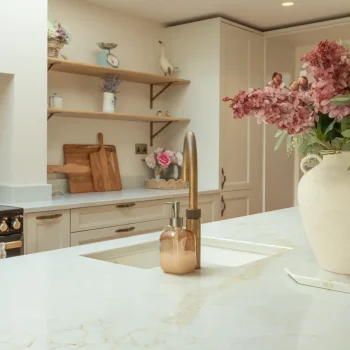
The Sienna Gold worktop from our Elorā collection combines a white background with bronze-toned veining and a polished finish. It is available in 20mm and 30mm thicknesses.
If you are comparing Sienna Gold quartz worktops, note that this Elorā product is an engineered mineral surface with 0% crystalline silica, rather than traditional quartz. Explore the product specifications and request a sample to compare the colour with your kitchen finishes.
Whenever possible, view the material before making your final choice.
Small photographs do not always show:
Our team can help you compare mineral surfaces with quartz, granite, sintered stone and other worktop materials before you decide.
A mineral worktop is a broad term used for engineered surfaces containing mineral materials. It may refer to mineral composite solid surfaces, hybrid mineral surfaces or newer engineered slabs manufactured with reduced or zero crystalline silica.
No. Quartz is one type of engineered mineral surface, but products marketed as mineral worktops can use different compositions and manufacturing methods.
Not all mineral worktops are silica free. The crystalline silica content depends on the individual product. Elorā mineral surfaces are engineered to contain 0% crystalline silica.
Some mineral composite and solid surface products can be sanded and refinished to remove minor scratches. Other engineered mineral slabs cannot be repaired in the same way.
Heat resistance depends on the material. Solid-surface mineral composites generally have lower direct-heat tolerance than sintered stone. Heat protection is recommended for all kitchen worktops.
Some mineral composite products may cost slightly less than premium quartz, while newer hybrid and 0% crystalline silica engineered surfaces can be priced at a similar level.
Mineral worktop prices vary by product, thickness, finish and project requirements. Compare the current prices on our Elorā collection page, then request an itemised quotation for your kitchen.
If you are considering a mineral worktop for your kitchen, our team can help you compare mineral surfaces, quartz, granite and sintered stone.
View the available colours and finishes, discuss your kitchen requirements and request a quotation based on your project.