Skip to content
If you’ve ever wiped your worktop clean and then noticed those white marks still sitting there, you already know how annoying limescale can be.
It usually starts small: a faint ring near the tap or a slightly dull patch where the kettle sits. But especially in hard-water areas, it can build up into something you can’t ignore.
The tricky part is that the products used on a kettle or sink are not always safe for a worktop. If you’re trying to remove limescale from quartz or granite worktops, the method matters. Using the wrong cleaner can damage the surface more than the limescale itself.
It’s simply hard water doing its thing.
When water dries, it leaves minerals behind. Over time, those minerals collect and harden, creating the white or dull build-up known as limescale.
You’ll usually spot it:
Whether the worktop is quartz or granite, both can start to look dull if water is regularly left sitting on the surface.
Quartz worktops are engineered, smooth, non-porous and generally easier to manage day to day.
Granite is natural, slightly porous, usually sealed and more sensitive if the wrong products are used.
The important point is that neither material likes strong acidic cleaners. Unfortunately, that is exactly what many standard limescale removers are.
If you’re still deciding between materials, our granite worktops guide and quartz worktops guide explain the differences in maintenance, durability and long-term use.
Products that can create problems include:
They may remove limescale, but they can also dull the surface, affect the finish and slowly damage the material over time.
The damage does not always appear immediately, which is why these products can seem safe at first. Repeated use is when the difference may become noticeable.
The right method depends on how much limescale has built up. There is no single approach for every situation.
Keep it simple. A pH-neutral cleaner made for stone surfaces is usually enough.
The drying step matters. Leaving water sitting on the surface simply starts the problem again.
This usually means the limescale has started to build up.
You will often feel the difference as soon as the deposit has been removed.
For older build-up, a baking soda paste can soften the limescale gradually without attacking the surface like an acidic cleaner.
Mix baking soda with a little water until it forms a paste. Spread it over the affected area and leave it for a few hours, or overnight for more stubborn deposits.
Once it is wiped away, most of the softened limescale should come off with it.
You do not need complicated equipment, but the right tools make a difference when limescale has built up over time.
Helpful tools include:
These can gently lift and break down the limescale without damaging the surface.
For more stubborn deposits, some people use a razor blade, but it must be kept flat against the surface and used very carefully. If you are unsure, avoid it.
Stay away from:
If a tool feels harsh, it usually is.
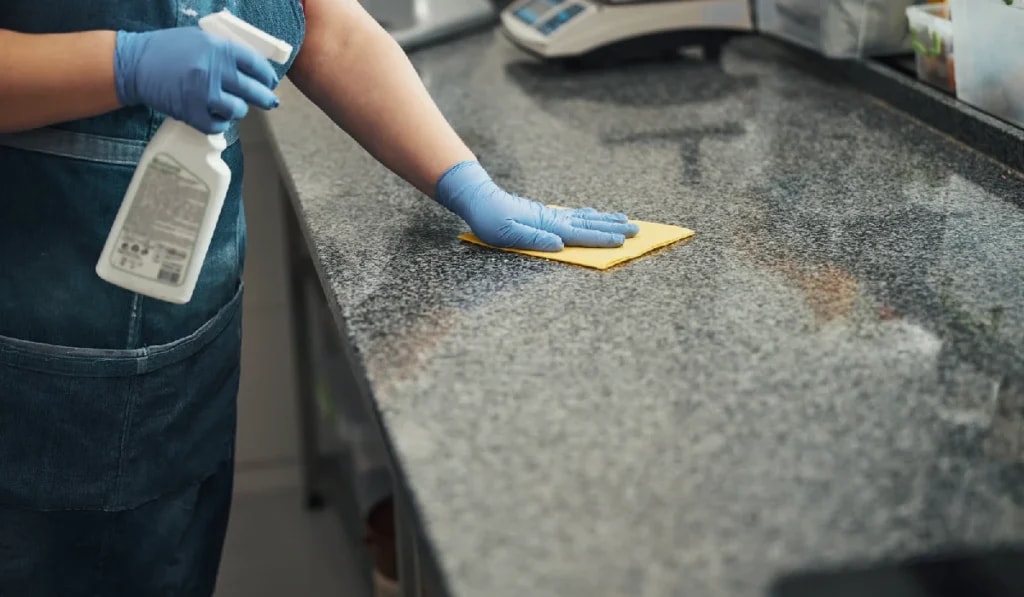
If you apply cleaner straight to a hardened deposit, it may struggle to work effectively.
Gently loosening or lifting the surface layer first allows the cleaner to reach the remaining build-up properly.
It is less about force and more about doing the work in the right order.
No.
Although vinegar is frequently recommended online, it is not designed for these surfaces. Damage may not be obvious immediately, but repeated use can leave a worktop looking dull or uneven, particularly quartz.
It is one of those products that seems harmless until the effect begins to show.
Removing limescale is one thing. Preventing it from building up again is what saves time.
A few small habits make a noticeable difference:
These steps take only seconds but stop the problem before it starts.
Cleaning is only one part of keeping quartz in good condition. Heat can also affect the surface more than people expect, so the guide on using hot pans on quartz worktops explains what is safe and what to avoid.
Warm water, a little washing-up liquid and a soft cloth are more than enough for everyday cleaning.
A proper stone cleaner can make the routine easier when you would rather not second-guess which product is safe. That is why the cleaner from Mo’s Stonex was put together: to provide something suitable for both quartz and granite worktops.
If you are dealing with marks beyond limescale, the guide on how to clean kitchen worktops from stains covers different stain types and suitable methods.
Many problems come from trying to fix the build-up too quickly.
Common mistakes include:
These habits do not solve the problem long term and can make the worktop look worse over time.
It is usually better to get advice rather than experiment if you are dealing with:
It is a worktop, not a test surface.
Use a stone-safe cleaner or a baking soda paste. Avoid acidic products.
Use a product designed for stone surfaces. If in doubt, keep the method gentle.
Not permanently in most cases, but it can make the surface look dull and feel rough.
Hard water. Unless the surface is dried, the mineral deposits will continue to form.
Limescale is not really the problem; it is how it is dealt with.
Use the wrong product and you can create a bigger issue. Use the right approach and it becomes part of normal maintenance.
Once you get into the habit of dealing with it early, it stops being something you have to think about.
If you ever need help with cleaning, maintenance or choosing a new worktop, Mo’s Stonex can guide you through it properly — from start to finish.